
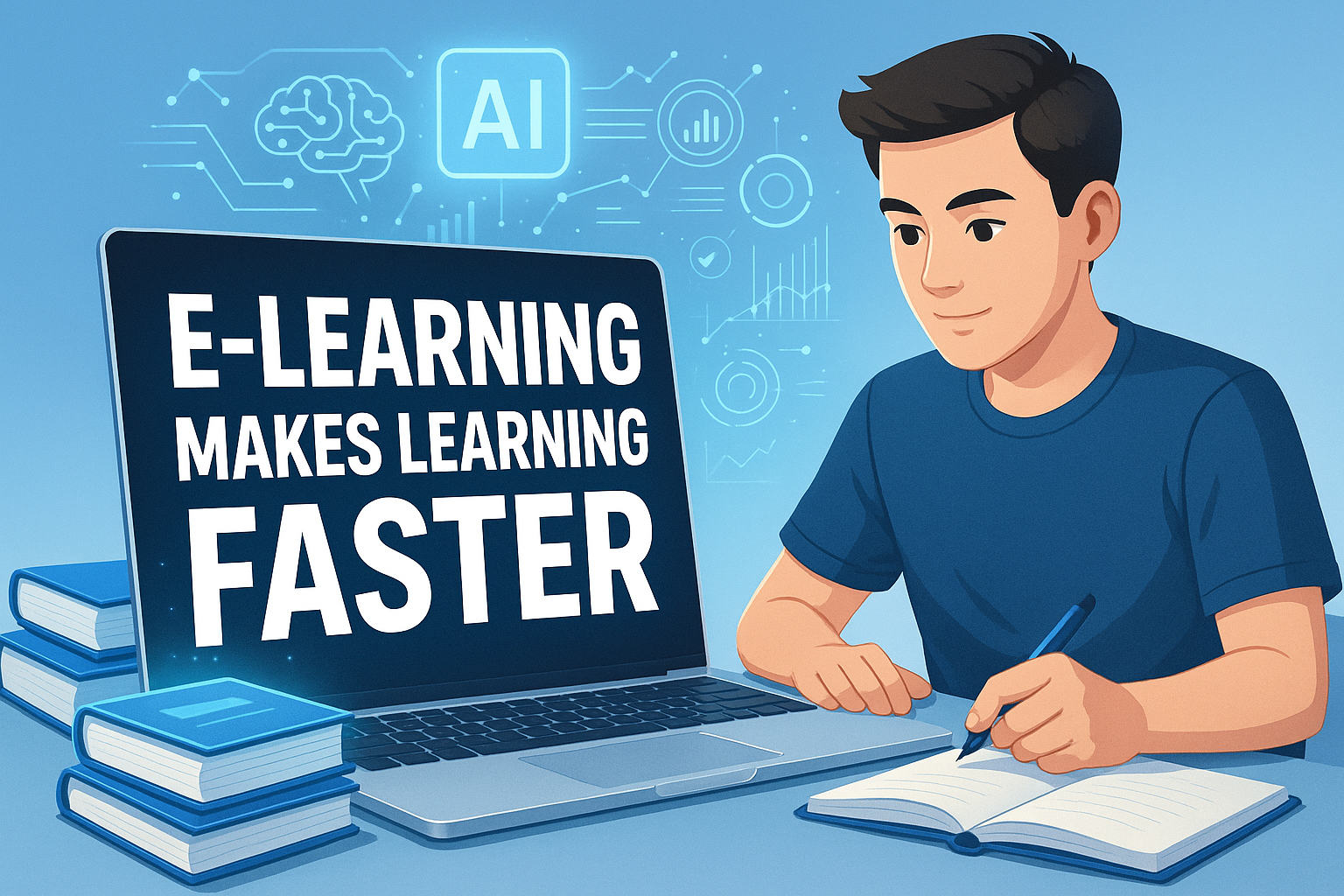
Introduction
Education has changed more in the last ten years than in the previous century. From handwritten notes and physical classrooms, students have moved into a world where learning is available from phones, laptops and smart devices. This shift has created a powerful learning system known as e-learning. Today, millions of students rely on online education for school subjects, skill development, competitive exams, and career training.
But the most interesting question is: Why are students learning faster with e-learning than traditional methods?
The answer lies in how digital learning makes lessons easier to understand, more interactive, and more personalized. E-learning gives students control over how they learn, how quickly they move through lessons, and how many times they want to revise. As a result, learning becomes faster, smarter, and far more effective.
This blog explores how e-learning accelerates learning speed, why it works better for the modern generation, and what makes it the future of global education.
E-Learning Allows Students to Learn at Their Own Pace
One of the biggest advantages of e-learning is flexibility. In traditional classrooms, every student must follow the same pace even if they understand concepts differently. Some learn fast, while others need more time. But the teacher cannot slow down or speed up for every student.
E-learning removes this limitation completely. Students can pause, rewind, replay, and revise lessons as many times as needed. This reduces pressure and increases clarity. When students learn at their own comfortable pace, their understanding becomes deeper and faster. The ability to control the speed of learning helps the brain absorb information more naturally.
Interactive Lessons Make Learning More Engaging
Online learning uses animations, visuals, quizzes, simulations, and storytelling to explain concepts. These interactive methods activate multiple parts of the brain, making it easier to remember information. Instead of reading pages of text or listening to long lectures, students see real examples, watch visual explanations, and participate in activities.
Interactive learning keeps students alert, curious, and motivated. When learning becomes enjoyable, the brain processes information more quickly and efficiently. This is why e-learning content often leads to faster understanding compared to traditional textbooks.
Access to Information Anytime, Anywhere
E-learning offers 24/7 access to study material. Whether a student wants to learn late at night, early in the morning, or during travel, everything is available instantly. This allows students to use their free time effectively.
In traditional education, students must rely on school hours or tuition timings. But e-learning removes these restrictions. Learning becomes flexible, continuous, and convenient. With more opportunities to study, students naturally learn faster.
Personalized Learning Paths Improve Understanding
Every student has a unique learning style. Some prefer visuals, others prefer reading, and some learn best through practice. E-learning platforms use AI to analyze each student’s patterns and create personalized paths.
For example, if a student struggles with math problems, the platform may suggest extra practice sessions. If another student is strong in languages, it may accelerate their lessons. Personalized learning ensures students do not feel lost or bored. When lessons match their skill level, they progress faster and with more confidence.
Instant Feedback Speeds Up Improvement
Traditional learning often delays feedback. Students take a test, and the results come days later. By then, they may forget the mistakes they made.
E-learning solves this problem with instant results. Whether it’s a quiz, assignment, or practice test, feedback is given immediately. Students instantly see where they went wrong and correct their mistakes on the spot. This real-time feedback system greatly accelerates improvement and helps students retain knowledge quickly.
E-Learning Encourages More Frequent Revision
Revision is a key part of learning faster, and e-learning makes revision extremely convenient. Recorded lessons, digital notes, practice quizzes, and flashcards allow students to revise whenever needed. Since everything is stored online, they can easily repeat important topics before exams.
Frequent revision improves memory retention and strengthens understanding. The ability to revise instantly, without waiting for teachers or physical books, is one of the biggest reasons students learn faster with e-learning.
Gamification Makes Learning More Motivating
Many e-learning platforms use gamification — elements like scores, badges, rewards, levels, and challenges. This makes learning feel like an enjoyable game rather than a boring task.
When students compete with themselves or with others, they stay motivated for longer periods. Motivation directly increases learning speed. Gamification also reduces stress and encourages consistent practice, which leads to faster academic progress.
Better Focus Through Distraction-Free Learning
Traditional classrooms often have noise, interruptions, or distractions that break concentration. E-learning, on the other hand, allows students to choose their ideal environment. They can study in a quiet room, use headphones, or customize screen settings to reduce distractions.
With better concentration, students absorb lessons more quickly. Digital learning platforms also use focused layouts, minimal designs, and structured lessons, helping students maintain attention throughout the study session.
Availability of Diverse Learning Resources
E-learning provides access to unlimited resources — videos, articles, animations, expert lectures, global courses, and more. Students are no longer limited to one teacher or one textbook. They can learn from top educators around the world.
This variety helps students understand topics from different perspectives, which speeds up learning. If one explanation is unclear, they can simply choose another. With so many resources at their fingertips, students learn faster and more confidently.
Practical and Real-World Learning
Unlike traditional learning, which is often theoretical, e-learning uses real-world examples, simulations, and practical demonstrations. Whether it’s science experiments, programming projects, business case studies, or language practice, e-learning makes concepts more realistic.
When students see how knowledge applies in the real world, they understand it more deeply and remember it faster. Practical learning also builds problem-solving skills, which speeds up their ability to learn and apply new information.
Reduced Learning Pressure Improves Performance
Traditional education often brings stress due to fixed schedules, heavy homework, and competitive classroom environments. High stress slows down learning and affects memory. E-learning creates a relaxed learning environment. Students can learn without pressure, take breaks when needed, and study in their comfort zone.
With lower stress, students’ brains function better, leading to faster learning and improved performance. The emotional comfort offered by e-learning plays a major role in boosting learning speed.
E-Learning Prepares Students for Future Jobs
Digital skills are essential for modern careers. When students use online learning platforms, they also learn digital communication, critical thinking, time management, and technological competence. These real-world skills improve overall learning efficiency and help students adapt quickly to changing environments.
Because e-learning aligns with future job requirements, students become faster learners not only academically but also professionally.
Cost-Effective Learning Increases Access and Continuity
Traditional education can be expensive due to travel, books, coaching classes, and physical resources. E-learning reduces many of these costs, enabling students from different backgrounds to access high-quality education.
When education becomes affordable, students can continue learning without interruption. Continuous learning naturally leads to faster progress.
Conclusion
E-learning is not just an alternative to traditional education — it is a faster, smarter, and more effective learning system. By offering flexibility, personalized lessons, interactive content, instant feedback, and practical learning, e-learning helps students learn more efficiently and remember information for longer. It reduces stress, increases motivation, and makes knowledge accessible anytime and anywhere.
As digital technology continues to evolve, e-learning will become even more powerful. The combination of AI, gamification, virtual classrooms, and intelligent study systems will further accelerate how quickly students learn. The future of education will be shaped by digital tools, and students who embrace e-learning today will be the fastest learners of tomorrow.
