
Introduction
Classrooms around the world are changing faster than ever before. Blackboards have turned into digital screens, textbooks have shifted to tablets, and online platforms have replaced many traditional learning systems. But the biggest transformation of all is the integration of Artificial Intelligence (AI) in education. AI is not just a tool; it is becoming a powerful educational partner that understands student needs, supports teachers, and reshapes how learning happens.
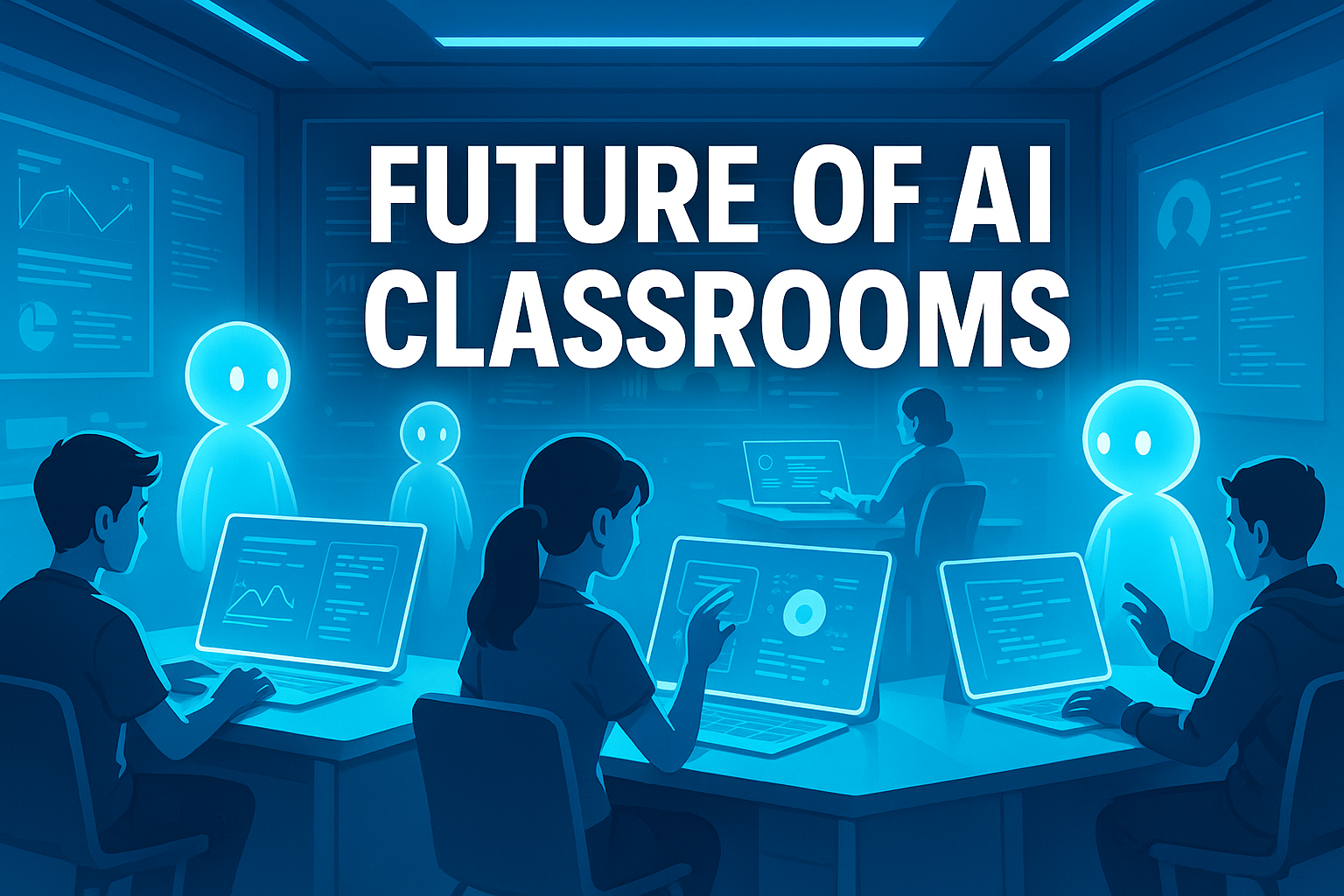
As AI technology becomes more advanced, classrooms will no longer rely solely on human-led teaching. Instead, they will evolve into hybrid learning environments where AI assists, guides, analyzes, and personalizes learning for every student. The future classroom will be smarter, more adaptive, and more engaging than any traditional setup.
This blog explores how AI will transform classrooms in the coming years, the experiences students can expect, and the new role teachers will play in this evolving educational era.
AI Will Create Personalized Learning Experiences
Every student learns differently. Some understand lessons quickly, while others need more time. Some like visuals, some like reading, and others prefer hands-on learning. Traditional classroom systems often struggle to meet these diverse needs.
AI solves this barrier by creating personalized learning paths for each student. It studies how students respond to lessons, which topics they find difficult, how fast they progress, and what learning style suits them best. Then it adjusts lessons automatically.
In the future classroom, each student will have a customized learning experience. Instead of everyone learning the same thing at the same speed, AI will ensure every student receives exactly what they need. This personalization will dramatically improve learning outcomes.
Intelligent Tutors Will Support Students Anytime
AI tutors are one of the most revolutionary elements of the modern classroom. They act like virtual teachers available round-the-clock. Students can ask questions, request explanations, solve practice problems, and get instant feedback.
In the next decade, AI tutors will become even more advanced. They will understand student emotions, detect confusion, break down complex concepts into simple explanations, and guide students step-by-step. These AI tutors will be patient, non-judgmental, and always available — something traditional systems cannot always provide.
With AI tutors, no student will ever feel stuck or left behind.
Smart Classrooms Will Use Predictive Analytics
Predictive analytics allows AI to foresee student performance based on their learning patterns. Schools will no longer wait until a student fails a test to identify academic challenges. Instead, AI will detect problems early and send alerts to teachers and parents.
For example, if a student consistently struggles with math concepts, AI will notify the teacher, recommend additional exercises, and adjust the student’s learning schedule. AI will also track attendance, engagement, attention levels, and emotional well-being.
With these insights, teachers can offer timely support, helping students stay on track before issues escalate. Predictive analytics will make classrooms more proactive than reactive.
AI Will Make Classrooms More Interactive and Engaging
Future classrooms will combine AI with interactive tools such as digital boards, virtual reality, and intelligent content systems. Lessons will no longer be limited to textbooks and lectures. Students will interact with holograms, simulations, and virtual environments that bring learning to life.
Science students will explore human anatomy in 3D. History lessons will include virtual tours of ancient civilizations. Geography students will experience climate patterns in immersive simulations.
AI will automatically adjust the difficulty level, pace, and visuals based on the classroom’s response. This level of interactivity will make learning enjoyable, effortless, and much faster than traditional methods.
Automated Grading Will Save Teachers Time
One of the most time-consuming tasks for educators is grading tests, assignments, quizzes, and homework. AI will handle this efficiently and fairly. It will evaluate written responses, analyze grammar, assess creativity, and even measure problem-solving skills.
Automation means teachers will no longer spend hours reviewing papers. Instead, AI will produce detailed reports for each student, showing strengths, weaknesses, and improvement areas. Teachers will have more time to focus on interactive teaching, lesson planning, and student engagement.
AI-based grading will also eliminate human bias, providing a more accurate and transparent evaluation system.
AI Will Improve Classroom Management
Managing a classroom with different personalities, learning levels, and behaviors is challenging. AI systems will analyze student participation, attention spans, behavioral patterns, and overall energy levels in the classroom.
If students appear distracted, confused, or stressed, AI will alert the teacher or adjust the teaching method automatically. AI-powered attendance systems will track students automatically through facial recognition. Classroom organization, timetable allocation, resource distribution, and scheduling will become automated.
With AI assisting in classroom management, teachers will spend less time on administrative tasks and more time guiding students.
Virtual and Augmented Reality Will Supercharge Learning
AI will enhance virtual reality (VR) and augmented reality (AR) experiences in classrooms. These technologies allow students to explore subjects in depth through immersive environments.
Imagine students attending a virtual field trip to space or walking through a digital museum without leaving the classroom. AI will personalize these experiences based on curriculum goals. It will track student understanding during VR sessions and adjust lessons afterward.
AI-driven VR and AR will make complex topics easier to understand and more enjoyable to learn.
AI Will Support Students With Special Needs
The future classroom will be more inclusive. AI tools will help students with disabilities by providing tailored learning experiences. Speech recognition, predictive text, emotion detection, personalized interfaces, and adaptive content will make learning accessible to everyone.
For example:
- Students with hearing challenges will receive real-time subtitles.
- Students with dyslexia will get personalized reading assistance.
- Students with motor disabilities will use voice commands to navigate lessons.
AI will ensure all students learn effectively, regardless of their physical or learning challenges.
Teachers Will Become Learning Mentors Instead of Information Providers
AI will not replace teachers. Instead, it will empower them. Teachers will shift from information providers to mentors, facilitators, and emotional supporters. With AI managing repetitive tasks, teachers will focus on creativity, critical thinking, problem-solving, and interpersonal development.
They will guide students through discussions, encourage teamwork, help with emotional needs, and ensure a healthy learning environment. AI will strengthen the teacher-student bond by giving teachers more time to interact meaningfully with students.
Data-Driven Insights Will Improve Teaching Methods
Teachers often rely on experience and observation to understand student progress. AI will provide accurate, data-driven insights showing which teaching methods work best, which topics students struggle with, and how classroom dynamics change over time.
These insights will help teachers refine their approaches, adopt better strategies, and improve learning efficiency. With the help of AI, teaching becomes more scientific, effective, and tailored to student needs.
AI Will Enable Global Classrooms
The future of learning will break physical boundaries. AI will connect classrooms across the world. Students will participate in global discussions, group projects, and cultural exchanges.
AI translation tools will eliminate language barriers, allowing students from different countries to learn together. Global classrooms will strengthen communication skills, cultural understanding, and global awareness.
The Future Challenges of AI in Classrooms
While AI promises incredible benefits, it also brings challenges. Schools must ensure data privacy, prevent over-reliance on technology, and ensure equal access for all students. Teachers must receive proper training to use AI tools effectively. Ethical guidelines must be followed to ensure AI supports humanity, not controls it.
However, with thoughtful planning, these challenges can be solved.
Conclusion
The future of classrooms with AI integration is filled with possibilities. AI will create a personalized, engaging, and efficient learning environment where every student receives attention and support. It will simplify teaching, automate tasks, enhance interactions, and prepare students for future careers. Classrooms will become smarter, more interactive, and more connected than ever before.
AI is not replacing education; it is transforming it into something more powerful and inclusive. The next decade will mark the beginning of a new educational era — one where technology and human creativity come together to shape a brighter future for students worldwide
